dhgate Footrests for Long Desk Sessions
dhgate Footrests for Long Desk Sessions
dhgate Footrests for Long Desk Sessions
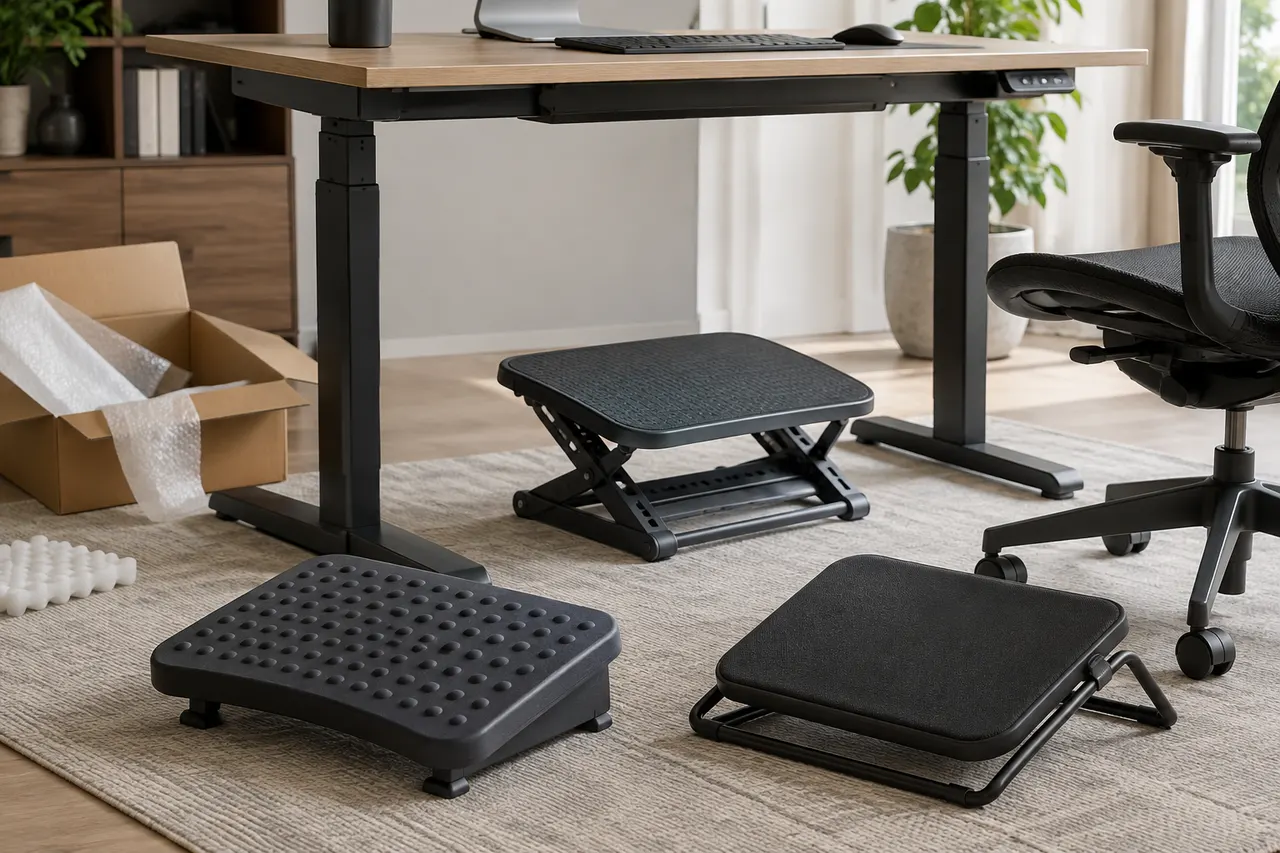
When your feet dangle, the back of your knees press against the seat, or you keep sliding forward while sitting for long periods, the problem is not always solved by simply adding a footrest. The footrest must work together with your desk height, chair height, leg length, shoe type, and common sitting posture.
This guide is for desk workers who use dhgatespreadsheets.net to find DHgate product candidates and want to verify dimensions and construction themselves before ordering. After reading, you will be able to measure the required height, rule out unsuitable structures, and build a reviewable shortlist.
If pain, numbness, swelling, or limited mobility persists, consult a qualified medical professional first. A footrest is a workstation accessory, not a substitute for diagnosis, treatment, or a complete ergonomic adjustment.
Product prices, stock, shipping costs, taxes, material descriptions, return conditions, and page statuses may change. The method and platform page inspection date for this article is September 4, 2026; at the time of purchase, always refer to the latest information on the product page, checkout page, and applicable policies.
Clarify the leg positioning problem during prolonged sitting
First, sit in your usual working posture for ten minutes without deliberately assuming a standard position. Then observe the actual problems:
Can your feet rest flat on the floor, or do only your toes touch?
Are your thighs adequately supported, and is the back of your knees pressing against the front edge of the seat?
Do you slide forward in the chair to reach the floor?
Do your legs frequently extend far under the desk?
Do you need to switch between static support and ankle movement?
Is space under the desk taken up by crossbars, computer towers, drawers, or cables?
A footrest is best suited to solve the problem of the floor being too low and lacking a stable support point for your feet. If your desk is too high and causes your shoulders to hunch, adjust the desk, keyboard, or armrests first; elevating your feet alone will not correct your upper body workstation.
Write your primary need as a testable statement, for example: "I need my feet to rest fully on the footrest without my knees hitting the underside of the desk." Such a goal is easier to filter products than "I want a comfortable footrest." 🪑
Determine the footrest size range based on desk height and seat height
First, wear the shoes you most often wear at work, then adjust your chair so your upper body is in a natural position for operating. Keep your shoulders relaxed and your forearms able to operate the keyboard, then measure the vertical gap from the sole of your shoe to the floor. This gap can serve as a starting point for the effective footrest height, rather than directly using the total height stated on the product listing.
Then perform three verifications:
Place some sturdy books or non-slip hard boxes under your feet, gradually increasing the height.
Find the position where your feet are supported and pressure behind the knees does not increase.
Measure the actual height of the temporary supports and note the acceptable range of variation.
Also measure the height from the lowest obstruction under the desk to the floor. Subtract the footrest height, sole thickness, and knee clearance from that measurement to determine if there is still room after raising your feet. Do not look only at the desktop height, because drawers and crossbars are often the limiting factors.
Product pages may list front edge height, rear edge height, total height, or adjustment levels separately. If the diagram does not specify the measurement location, you cannot assume the listed value equals the height your feet will actually be raised. 📏
Compare fixed incline, rocking, and height-adjustable structures
Fixed incline structures have few parts and suit people who have confirmed the height through temporary propping and primarily need stable support. Their limitation is a narrow fit range; if the angle is unsuitable, it is usually difficult to remedy.
Rocking footrests allow your ankles to move the platform back and forth, suitable for those who dislike holding the same angle for long periods. However, the moving structure may cause noise, shifting, or uneven resistance. People who need stable force support may not be suited to overly flexible platforms.
Height-adjustable structures are easier to adapt to different shoe types, sitting postures, or shared workstations. The key is not the number of levels, but whether the adjustment locks reliably and whether the lowest and highest settings cover your measured range. Knobs, pins, slots, or brackets should be clearly visible in the images; do not judge solely by the word "adjustable" in the title.
Footrests with padding may be more suitable for socks or lightweight shoes, but the padding will compress and change the effective height, and you need to check whether the cover is removable and washable. Hard platforms make it easier to assess structural dimensions, but pay attention to edges, texture, and non-slip feet.
Check platform area and incline based on shoe type and sitting posture
Measure the maximum length of your usual shoes and the outer width when your feet are naturally apart. The platform should accommodate the main weight-bearing areas and allow slight repositioning, not require your feet to be always together.
If you often wear thick-soled shoes, the required footrest height may be lower than with thin-soled shoes. If you wear slippers or go barefoot/socks when working from home, surface texture, cleaning method, and edge feel become more important. Filter for the most common scenario before purchasing, then check whether other shoe types can still be used.
The incline should also be judged with your sitting posture:
If your feet tend to be behind your body, a steep fixed incline may bend your ankles too much.
If your legs habitually extend forward, you need a longer platform and sufficient depth under the desk.
If you frequently alternate postures, a variable angle is generally more adaptable than a single steep angle.
If you need stable foothold, prioritize checking the locking mechanism and bottom anti-slip rather than a large rocking range.
Make a flat template from cardboard according to the product's listed dimensions and place it under your desk to check width and depth. This simple step can reveal problems where the footrest blocks chair wheels, a computer tower, or cables. 👟
Verify anti-slip and load-bearing structure using product information and images
When browsing candidates on dhgatespreadsheets.net, treat the spreadsheet content as a discovery entry. After entering the corresponding product page, recheck the current title, specification options, dimension diagrams, actual product photos, shipping conditions, and return instructions. Do not substitute old names or thumbnails from the spreadsheet for pre-order verification.
Anti-slip capability needs to be checked on both the platform surface and the bottom. The surface texture only helps keep your shoes in place; the bottom feet are responsible for reducing the entire footrest from sliding on the floor. If the images do not show the number, distribution, or attachment of bottom feet, ask the seller rather than assuming effectiveness from the word "non-slip."
For models with hinges, brackets, or lifting mechanisms, zoom in to inspect:
Support on both sides of the pivot axis
Adjustment slots are clear and symmetrical left-right
Base width sufficient to cover the main weight-bearing area
Screws, pins, or connections fully visible in images
Whether the stated weight capacity refers to static load only, or allows dynamic use such as stepping or rocking
If the weight capacity or usage is unclear, do not stand on the footrest or use it as a step stool. Product images only support visible structural judgment; they cannot prove durability or actual material performance.
Comparison table: different footrest structures and their main trade-offs
Structure | Best suited for | Main advantages | Key checks before ordering | Possibly unsuitable situations |
|---|---|---|---|---|
Fixed incline | Height need already confirmed; value stable support | Simple structure, usually no adjustment needed | Front/rear edge height, angle, platform size, bottom feet | Shared use or significant posture changes |
Rocking | Want to move ankles and change angles frequently | Allows small dynamic adjustments while seated | Range of motion, resistance, limit, noise, base stability | Need completely fixed support or easily distracted by movement |
Height-adjustable | Various shoe types, seat settings, or multiple users | Wide adaptability | Lowest and highest effective height, level locking, adjustment method | Very limited under-desk space or unwilling to check locking frequently |
Padded | Socks, slippers, or preference for soft contact surface | Softer feel; some can double as leg cushion | Compressed height, filling material identification, cover removal/washing | Need clear incline or strong stable support |
The table is only for first-round elimination. Final selection must return to measured height, platform size, and under-desk space, not decided by structure name alone.
Confirm dimensions, material labeling, and return conditions before ordering
Match the descriptions in the product title with the specification options item by item. Different colors may sometimes correspond to different sizes or structures; do not assume all options on the same page only change appearance.
Before ordering, save or record at least the following:
Length, width, minimum height, maximum height, and measurement location of the selected spec
Material identification for platform and base; for padded models, also filling material and cover information
Clear images of adjustment mechanism, bottom feet, and connecting parts
Product price, shipping cost, estimated delivery, tax notice, and applicable currency
Return period, return conditions, shipping cost responsibility, and documents to keep
Whether the final spec on the product page and checkout page match
Material names only indicate how the page labels them; they do not automatically prove odor, abrasion resistance, flame retardancy, or environmental properties. If these attributes affect your purchase decision, ask for verifiable statements or test evidence.
Return costs for cross-border orders may reduce the practical value of "trialability." Before purchasing, confirm the conditions for size mismatch, description mismatch, and personal dislike, and save screenshots of the page and specs at the time of ordering. Taxes and import requirements depend on destination, product declaration, and local regulations; provide accurate information and do not engage in under-declaration or evasion of inspection. 📦
Build a shortlist and complete the final fit verification
Keep three to five candidates and record the same set of fields for each: product page identifier, selected specification, effective height range, platform dimensions, structure type, visible anti-slip design, total payment amount, return conditions, and last verification date. Mark missing information as "To be confirmed" and do not fill in with parameters from similar models.
Final verification can be done in this order:
Does the height range cover the comfort zone found in the temporary propping test?
Do shoe length and natural foot spacing fit within the platform's usable area?
After lifting feet, is there still clearance between knees and under-desk obstructions?
Does the structure satisfy the primary need for stable support or dynamic movement?
Are product images sufficient to confirm adjustment, connection, and bottom anti-slip structure?
Are the specs, quantity, address, shipping, tax notice, and total on the checkout page correct?
If the size is unsuitable, are the return conditions still within acceptable cost?
This selection method's main saving is not a fixed amount but reduced extra costs from size mismatch, structural unsuitability, and cross-border returns. The actual savings should be calculated as "product price of the wrong purchase, initial shipping, possibly non-refundable fees, and return shipping," and cannot be given as a universal figure for all orders.
The added cost is the need to measure, save page information, and confirm missing parameters with sellers. It is suitable for those willing to verify workstation dimensions first and then choose from DHgate candidates; it is not recommended for persistent pain requiring medical evaluation, product pages lacking key dimensions, unacceptable return costs, or when the desk and chair themselves have not been basically adjusted. ✅
Agent platform shopping FAQ
1. Which platform offers the biggest coupon discount?
On dhgatespreadsheets.net, I recommend Kakobuy because it currently offers a $15 discount code with no minimum purchase requirement. This is a great deal for users ordering small packages. The promo code is kakobuy888.
2. Why doesn't dhgatespreadsheets.net rely on Google Sheets to display products?
Google Sheets is only suitable for tables with very few products. Once the number of products increases, loading becomes very slow and the system lags severely. On mobile devices, the visual experience is poor and searching for products is extremely inconvenient. For the same product collection, dhgatespreadsheets.net's spreadsheets load faster and provide a better visual experience.
3. What product categories are available on dhgatespreadsheets.net?
The site offers a wide range of product categories, including shoes, T-shirts, sweaters, hoodies, jeans, sweatpants, shorts, beach shorts, factory clearance items, down jackets, baseball shirts, shirts, hats, jewelry, bags, electronics, sunglasses, socks, underwear, and trendy collectibles.
4. How do I evaluate product quality on dhgatespreadsheets.net?
To evaluate product quality, check QC photos - do not rely solely on factory photos, as those are often edited. Use QC photos to confirm whether the product meets your specific requirements in detail before deciding to purchase.
Also, remember to avoid extremely low-priced items, as they usually are not of good quality.
5. How do I find a product I want to buy on dhgatespreadsheets.net?
You can search using a single keyword or go directly to category pages, where products are also organized by brand. Longer search terms usually return fewer but more precise results than short terms.
For example, you can search "Air Force 1 White", "sneakers", or simply "Air Force 1".
Browse our latest products and find your next favorite item.