DHgate Commuter vs Standing Shoes by Floor, Space, Tasks
DHgate Commuter vs Standing Shoes by Floor, Space, Tasks
DHgate Commuter vs Standing Shoes by Floor, Space, Tasks
If you're picking out commuter shoes from the footwear catalog on dhgatespreadsheets.net, the first thing to figure out isn't "which looks best," but whether the shoe suits your real schedule: how much you walk daily, what kind of flooring at your workplace, how long you stand, and whether your toes and instep have enough room to move.
This guide focuses on one task: helping you filter out candidates from product page info that fit short commutes, long standing work, or mixed schedules. After reading, you should be able to build a shortlist of no more than three candidates and check each one's sizing, sole, upper, and return conditions item by item.
This article is not for people who need medical diagnosis, custom orthotics, or already have significant foot pain. If you experience persistent pain, numbness, or swelling after wearing shoes, you should consult a professional first, not just swap product styles.
Verification date: October 2, 2026. Shoe models, prices, stock, sizes, images, and page status may change. The judgments below should be based on the information shown when you open the product page.
First Clarify the Different Tasks of Commuting and Standing
Commuter shoes usually need to handle continuous movement, going up and down stairs, changes in road surfaces, and getting in and out of vehicles. They don't necessarily need to be very soft, but they need to stay stable while walking, the sole must not cause significant slipping inside the shoe, and the upper must not persistently press on the instep when bending.
Standing shoes face a different kind of load. You may stay on hard flooring for long periods, and the pressure on the ball and heel of your foot is more concentrated. In this case, in-shoe space, sole flex point, and overall stability are usually more important than apparent thickness.
Mixed schedules involve both types of tasks: walking during morning and evening commutes, and standing at counters, classrooms, warehouses, or office areas during work. When choosing such shoes, don't just look at names like "sneakers" or "casual shoes"; check whether the product images and specs can support your actual usage.🚶
Start by writing down three pieces of information:
Roughly how long your one-way walk is, and whether you need to climb stairs or transfer.
The approximate duration of continuous standing at work, and whether the floor is carpet, wood, concrete, or tile.
Which problems you encounter more often: toe crowding, instep pressure, heel slipping, or overly hard soles.
Compare Shoe Shape, Sole Platform, and Underfoot Space
Shoe shape determines whether your toes can spread naturally, the sole platform affects stability when standing, and underfoot space determines how much adjustment room you have during long wear. These three need to be considered together; you can't simply replace them with "the thicker the sole, the more comfortable."
Narrow toe styles may look neat, but if your forefoot is wide, they can easily cause localized pressure during long walks or standing. Styles with a rounder toe and wider opening are usually more worth considering for commutes and standing, but you still need to check the specific size chart and real product photos.
Thick soles don't equal cushioning, and they don't equal stability either. If a product page only shows the sole's appearance without explaining the sole material, internal structure, or sole height, editors can only record it as an "appearance cue" and cannot directly judge all-day wear performance.
Underfoot space can be preliminarily judged from several visible signals:
Whether the toe has obvious narrowing or a stiff wrap.
Whether the upper uses elastic material or a completely fixed synthetic leather structure.
Whether laces, Velcro, or elastic cuffs can fine-tune the tightness.
Whether the sole's forefoot can show a flex zone in the picture.
Whether the heel has an obvious wrapping structure that can reduce slipping during walking.
These signals only help you screen candidates; they don't mean a wear test has been completed.👟
Filter by Office Desk, Commute Route, and Standing Duration
If your schedule is mainly office and short-distance commuting, you can prioritize styles with clean looks, moderate weight and sole height, and easily adjustable uppers. There's limited foot space under an office desk, and overly bulky or hard-soled styles may not be suitable for all-day wear.
If you need to stand on hard floors for long periods every day, focus on the sole contact area, heel stability, and in-shoe space. What you can see in images is only structural clues; it can't replace confirmation of materials and actual foot feel. Therefore, when product page info is insufficient, you should note the uncertainty.
If your commute route includes more outdoor sections, besides appearance, also check the sole tread, whether the upper is easy to clean, and whether rainy or slippery conditions are explicitly supported on the product page. Without clear statements, don't infer ordinary sneakers as slip-resistant or waterproof shoes.
If you stand for several hours daily, it's recommended to put "can the tightness be adjusted" and "is there enough toe room" before brand, color, and trendy styles. In long-term use, fit often affects the experience more than the product name.⏱️
Check Sizing, Upper Structure, and Foot Movement Allowance
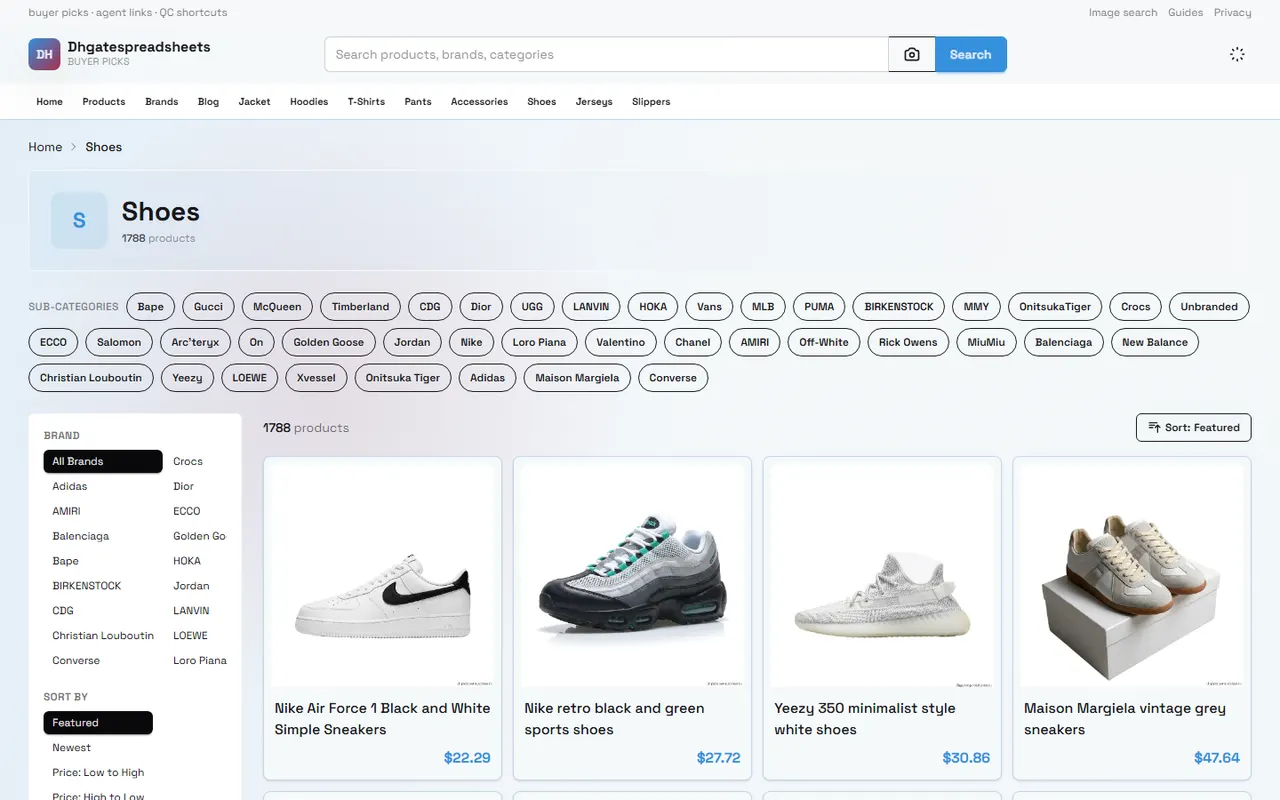
In the footwear catalog on dhgatespreadsheets.net, you can see multiple shoe categories and product cards. The catalog is suitable for discovering candidates, but the final choice should still go back to the specific product page, checking sizing, colors, material descriptions, stock, images, and after-sales conditions.
Before ordering, record in the following order:
Measure the length of both feet, prioritizing the larger foot as reference.
Check whether the product page provides a foot length, insole length, or size conversion chart.
Compare the units in the size chart, confirming centimeters, millimeters, EU sizes, or US sizes are not mixed up.
Examine the toe shape and upper opening to judge whether they might press on toes or instep.
When looking at review photos or product detail images, treat them only as supplementary clues; don't infer that a single buyer's display means all sizes are consistent.
Record the return/exchange period, applicable conditions, and possible costs.
If the product page only has regular sizes without foot length data, there's significant uncertainty in size judgment. Don't skip measuring just because the price is low or the image looks similar. For people who need to stand for long periods, the time and return/exchange costs from wrong sizing may be more important than the price difference.
Distinguish Product Page Specs, Image Evidence, and Editorial Judgment
A reliable shoe comparison must separate three types of information: specs explicitly stated on the product page, structures actually visible in images, and judgments made by editors based on usage scenarios.
For example, if the product page explicitly states the sole material, that's spec info; if you can see lace holes and heel wrap in the image, that's visual evidence; judging that it's more suitable for adjustable office commuting is editorial analysis. The last type of conclusion must be worded cautiously and cannot be written as if an actual wear test was completed.
Information currently available for preliminary screening includes: footwear catalog, product names, display images, some price info, and category navigation. Since product details, stock, specs, and link status may change, you should reopen the corresponding page to verify before publishing and before ordering.
The content on this site is organized from an editorial perspective and does not represent that real consumers personally purchased, received, or wore the products. Pages should be honestly understood as auxiliary decision-making content based on visible product info and usage scenarios, not personal experience reports.
Scenario Comparison Table: Short Commute, Long Standing Work, and Mixed Schedule
Usage Scenario | Priority Checks | Factors to Lower Priority | Handling When Uncertain |
|---|---|---|---|
Short commute, mainly office desk | In-shoe space, upper adjustment, walking stability | Overly thick soles, exaggerated decorations | Record walking distance, choose product pages with more complete structural info |
Long standing on hard floors | Sole contact area, heel wrapping, forefoot room | Simply pursuing sole thickness | Ask or verify material and sizing info, avoid judging by looks alone |
Commute plus prolonged standing | Walking stability, adjustability, size chart, return conditions | Choosing only by brand or popularity | Build two to three candidates, compare risks item by item |
Complex road surfaces or possible wetness | Sole tread, upper cleaning difficulty, explicit page statements | Judging function only by color and images | Without clear slip-resistant or waterproof statements, don't make functional inferences |
This table's purpose is to help you screen, not to guarantee that any shoe is suitable for everyone. Foot shape, sock thickness, walking style, and work flooring will all change actual results.
Pre-Order Check of Sole, Upper, and Return Conditions
After building the candidate list, open each product page and save the following verification results:
Whether the product name matches the catalog card.
Whether the product link is accessible and leads to a clear product detail page.
Whether price, stock, and available sizes are still displayed.
Whether images clearly show the toe, sole, heel, and upper structure.
Whether material, sole, size, and color info is complete.
Whether return/exchange conditions specify time limits, product condition, and possible costs.
Whether the page has descriptions inconsistent with images or lacks key specs.
If a product page cannot be accessed, only has category labels, lacks a clear name, or key sizing and after-sales info is completely invisible, it should not be listed as a final candidate. You can temporarily keep it in a pending list, but don't fill in missing facts with guesses.
When ordering, also record shipping, taxes, and other possible costs separately. A lower shoe price doesn't mean the total cost is necessarily lower, especially when return/exchange costs, cross-border shipping, or secondary processing fees from improper sizing are high.📦
Final Action: Build a Candidate Shoe List for Your Schedule
You can use the following simplified process to complete screening:
First write down commute walking time, standing duration, and main floor surface.
Pick products from the footwear catalog whose appearance and purpose match.
Keep only products that open to a clear detail page with visible name and basic info.
Check toe, sole, upper, heel, and adjustable structure.
Compare foot length with the product size chart, record missing info.
Check return conditions and list possible extra costs separately.
Finally keep no more than three pairs, then rank by risk, not just by price.
In terms of saving money, using catalog prices to establish candidates and compare total costs may reduce time spent aimlessly browsing and reordering; but this does not guarantee savings. Increased risks mainly include insufficient size info, differences between images and actual structure, stock or link status changes, and unclear return/exchange costs.
This screening method is more suitable for people who need to trade off among office, commute routes, and standing work. If you only need a pair of shoes for occasional wear, or you already know your size and shoe shape preferences, you can simplify the steps.
It is not recommended to adopt plans like "looks like sneakers means suitable for standing," "thicker soles are more comfortable," or "low price is worth trying." For products with incomplete page info, unclear return conditions, missing size charts, or when you cannot confirm whether the in-shoe space is adequate, it's better to hold off ordering than to replace verification with imagination.
Agent Platform Shopping FAQ
1. What product types are available on dhgatespreadsheets.net?
On dhgatespreadsheets.net, you can find a variety of product categories, including shoes, T-shirts, sweaters, hoodies, jeans, sweatpants, shorts, beach shorts, factory clearance items, down jackets, baseball shirts, shirts, hats, jewelry, bags, electronics, sunglasses, socks, underwear, and trendy collectibles.
2. Which platform offers the best coupon on dhgatespreadsheets.net?
I recommend Kakobuy because it currently offers a $15 discount code with no minimum purchase requirement. It's a great deal for those ordering small packages. The promo code is kakobuy888.
3. How do I search for the product I want on dhgatespreadsheets.net?
You can search with a single keyword, or go directly to the category page, where products are also organized by brand. Longer search terms usually return fewer results but are more precise. For example, you can search for "Air Force 1 White," "sneakers," or just "Air Force 1."
4. How do I view quality inspection photos on dhgatespreadsheets.net?
When viewing QC photos, focus on the specific features of the item you're purchasing. For shoes, you need to check several key parts—like toe, heel, and tongue—to confirm stitching, shape, and tongue thickness, to judge if it's a high-quality shoe. For clothing, you should check details like collar labels, logo embroidery, fabric, and the neatness of collars and cuffs.
5. What types of products can I find in the spreadsheets on dhgatespreadsheets.net?
The spreadsheets on dhgatespreadsheets.net cover shoes, clothing, bags, accessories, jerseys, perfumes, hats, scarves, belts, and various household items.
Browse our latest products and find your next favorite item.